The code whispers, but the soul listens.
On an unremarkable Tuesday, the news slipped through the noise of another bull market. Anthropic, the AI company born from a manifesto of safety, had begun preliminary research on a self-designed AI chip. Samsung was in the room, a whispered partner for manufacturing. The announcement was thin—four bullet points without a single technical detail, no architecture, no timeline. Yet the market twitched. The narrative of vertical integration, of escaping the grip of NVIDIA, had found a new vessel.
I read the report from a blockchain news feed, a source more accustomed to token launches than silicon plans. The lack of credibility was its own signal. When a tech story this embryonic bypasses the hardware press and lands in crypto media, something deeper is at play. It is not a chip story. It is a philosophy story, wrapped in the language of independence.
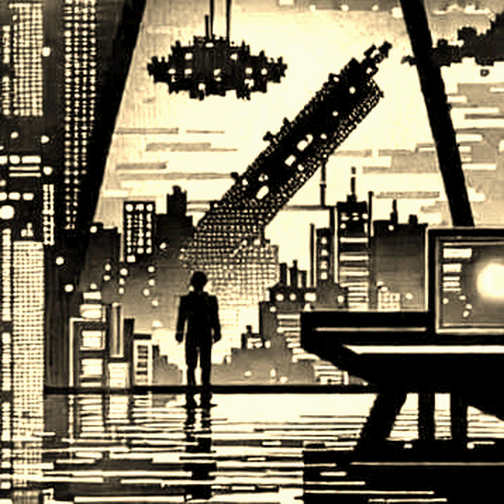
Context: The Cathedral in the Cloud
Anthropic currently runs its Claude models on tens of thousands of NVIDIA H100s and Google TPUs, hosted inside Google Cloud. Every dollar of API revenue flows through two monopolies: chip supply and cloud infrastructure. The company has raised over $7 billion, yet its entire operations sit on rented land. The move to design a custom chip, modeled after Apple’s M-series or Google’s TPU, is a bid for sovereignty. It echoes what we saw in DeFi during 2020: projects that built on Ethereum but dreamed of their own chain, their own sequencer, their own gas token.
But sovereignty is expensive. A chip tape-out at advanced nodes costs tens of millions, and mass production billions. The timeline is three to five years. In the meantime, NVIDIA will ship two more generations of GPUs, and the gap between Anthropic’s ambition and its current dependency will widen. This is not a short-term hedge. It is a long-term gamble on the idea that owning the silicon grants the right to define the soul.
Core: The Human Ledger of Hardware
As someone who spent the 2017 ICO boom auditing whitepapers for philosophical coherence—finding that 18 of 23 lacked any community value proposition—I recognize the pattern. A system reaches a scale where its survival depends on controlling its own substrate. Ethereum moved to rollups to escape L1 congestion. AI companies move to custom chips to escape GPU scarcity. Both are attempts to internalize a bottleneck. But the analogy breaks at the point of trust.
In blockchain, sovereignty means verifiability. You can run a node, audit a smart contract, permissionlessly exit. In hardware, sovereignty is opaque. Anthropic’s chip will be a black box. Its design decisions—what data paths to prioritize, what precision to optimize for, what security modules to include—will be made behind closed doors. The company that promises “Constitutional AI” will write the constitution of the chip itself. There is no fork for a physical chip. No social consensus to upgrade it. Once it’s in the datacenter, it is law.
We built towers of glass on beds of sand. The sand here is the assumption that vertical integration inherently serves decentralization. It does not. It serves the entity that owns the stack. Anthropic’s chip, if successful, will reduce its reliance on NVIDIA, but increase its reliance on itself. That is not decentralization. That is a new monolith, smaller but denser.
I have seen this before. In the DeFi Summer of 2020, I withdrew from public discourse to analyze 50 smart contracts. I found that most liquidity mining programs were subsidies for TVL numbers—stop the incentives, the users vanish. Anthropic’s chip is a subsidy for long-term narrative. It burns capital today to buy a story of independence tomorrow. The real users—the developers building on Claude—will not see the chip. They will see API prices, and those prices may drop if the chip works. But the price drop is not a feature of decentralization. It is a feature of internalized cost.
Silence is the most honest ledger. And here, the silence is deafening. No talk of open-sourcing the chip design. No mention of hardware-level trust. No promise that the chip will be available to competitors. This is a fortress, not a commons.
Contrarian: The Pragmatism Test
And yet, I must test my own cynicism. It is fashionable in crypto circles to critique centralized AI infrastructure. But the alternative—continuing to rent from NVIDIA—is worse. NVIDIA’s monopoly allows it to extract near-monopoly rents. Anthropic’s own model training costs are unsustainable without a path to cheaper compute. A custom chip, even if it takes five years, could cut inference costs by 10x. That would unlock applications currently too expensive: real-time conversation, autonomous agents, long-context reasoning. The ethical implication is real: lower cost equals broader access.
Moreover, the chip could be designed with safety in mind. Hardware trust modules, encrypted memory paths, tamper-resistant cores. Anthropic has the incentive to build a chip that aligns with its safety-first brand. That would be a net positive for the entire AI ecosystem—if they choose to share it. But the “if” is the key.
Truth is not mined; it is revealed in the dark. The dark here is the uncertainty of execution. Samsung’s 3nm GAA process has struggled with yield. Apple moved its modem business from Intel to Qualcomm after years of failed in-house efforts. The graveyard of custom chip projects is large. Anthropic could waste $2 billion and end up back at NVIDIA’s door, with less time and trust. The risk is not just financial—it is strategic. While engineers toil on silicon, a competitor like OpenAI may leapfrog in model capability.
Takeaway: Whose Center Do We Orbit?
Every bull market convinces us that the next vertical integration will bring freedom. The Ethereum merge promised scalability; it delivered L2 fragmentation. The Bitcoin ETF promised institutional alignment; it delivered diluted sovereignty. Now Anthropic’s chip promises independence from NVIDIA; but independence from one monopoly often means submission to another—the internal monopoly of a closed stack.
Faith in code requires a heart for humanity. The chip is code frozen in silicon. Its architecture will encode the values of its designers. Will it prioritize transparency? Will it allow third-party audits? Will it serve the community or the corporation? These are not technical questions. They are questions of soul. And the soul, like the code, whispers. But we must listen before we build.
I leave you with this: In the chaos of the chain, find your center. But whose center are we orbiting? The chip may be self-made, but the ledger of trust is still written in silence. Until that silence is broken by open commitments, we are building cathedrals on hope. And hope, unlike silicon, can shatter.